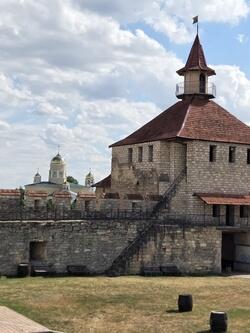
Bendery Fortress, Transnistria, history and imposing walls.
Photo. Bendery Fortress, Transnistria, set within beautifully maintained gardens, overlooking the peaceful Dniester River and the surrounding countryside.
© Travel Explorations.
Entering Transnistri, Russian name Pridnestrovie, felt strangely unreal. The border crossing itself was enough to spark my curiosity. Uniformed guards checked documents with serious expressions, reminding me that this was no ordinary destination. Although officially part of Moldova, Transnistria operates as its own state, complete with its own government, currency, and identity.
One place I was especially keen to visit was Bendery Fortress. I'd heard so much about its history and imposing walls that seeing it for myself had become one of the highlights I was most looking forward to.
This was the final stop on my journey through Transnistria, and it felt like a fitting place to end my trip. History feels remarkably close here. Built in 1538 by the renowned Ottoman architect Mimar Sinan. The fortress was designed to be one of the empire's strongest defensive strongholds. Its thick stone walls, deep moat and commanding position overlooking the Dniester made it a prize worth fighting for. Over the centuries, Ottoman, Moldavian and Russian forces all battled to control it. Even today, the fortress stands as a reminder of the many battles fought at this strategic crossing.
The grounds around the fortress are beautifully landscaped, providing a striking contrast to its military past. One part of the fortress I found difficult to linger in was the old torture chamber. The displays offered a stark reminder of the brutality that once took place within these walls. It was unsettling enough that I left after only a few minutes, preferring to spend my time outside rather than in the oppressive atmosphere below.
Instead, I wandered along the fortress ramparts. From there, I could appreciate the fortress as a whole, looking down into the courtyards on one side and out across the surrounding countryside on the other. The contrast was striking. Inside the walls lay centuries of conflict and suffering, while beyond them the Dniester River wound peacefully through a broad green landscape.
Before leaving, I climbed to the top of the main tower. The effort was well worth it. From the highest point of Bendery Fortress, the panoramic view stretched across the river, the town and the rolling countryside beyond. Standing there, it was easy to understand why this commanding position had been fought over for so many centuries.
From the ramparts, it was easy to see why Bendery Fortress was worth fighting for. For nearly five centuries, Ottoman janissaries, Moldavian soldiers, Zaporozhian Cossacks and Russian troops all battled for control of this strategic crossing over the Dniester. The fortress changed hands repeatedly during the Russo-Turkish Wars, while countless earlier sieges failed to breach its formidable walls. Looking across the river from the battlements, the peaceful landscape gave little hint of the bloodshed that had unfolded here over the centuries.
As I walked along the walls, what struck me most was how tangible the past still feels here. This is not a carefully staged historical attraction but a place where the setting itself tells the story. Looking across the river from the battlements, it was easy to understand why so many armies fought to control it.
Stein Morten Lund, 19th July 2026
Additional information
Transnistria, officially known as the Pridnestrovian Moldavian Republic (PMR) and locally as Pridnestrovie, is a landlocked breakaway state internationally recognised as part of Moldova. Transnistria controls most of the narrow strip of land between the Dniester river and the Moldova–Ukraine border, as well as some land on the other side of the river's bank. Its capital and largest city is Tiraspol. Locally, authorities and residents strongly prefer the Russian name Pridnestrovie over the internationally used term "Transnistria," because "Transnistria" is a Romanian term (meaning "beyond the Dniester") and is often viewed negatively by the local Russian-speaking population. The government even banned the official use of the word "Transnistria" in the territory.







 E-mail this
 Print this