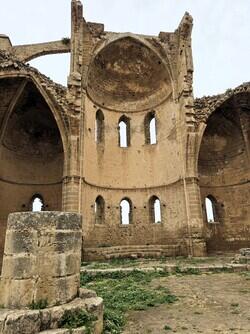
Church in Famagusta, Northern Cyprus
Photo.
Between stone and silence, these sacred sites whisper stories of devotion, loss, and endurance, where time seems to stand still and the echoes of belief remain.
In Northern Cyprus, beyond the imposing walls of Famagusta, a quieter history unfolds. Scattered across the landscape, abandoned churches and monasteries stand frozen in time, holding echoes of faith, memory, and lives once deeply rooted here.
Famagusta District is home to a remarkable yet often overlooked heritage of historic churches and monasteries. Many stand abandoned since 1974, preserving within their walls a powerful story of culture, faith, and resilience.
The path along the walls felt less like a walk and more like a slow passage through time. Each step carried the weight of centuries, Lusignan kings, Venetian engineers, Ottoman echoes are all layered into the same quiet horizon. And just beyond those massive fortifications, almost hidden in their shadow, stood the churches. Some intact, some broken, and all whispering.
I wandered into one near the walls, its roof partially open to the sky. Light poured in where a ceiling once was, illuminating fragments of carved stone and faint traces of saints. It struck me how these sacred places existed right beside structures built for war. Defense and devotion, side by side. One meant to keep the world out, the other to reach beyond it.
In Famagusta District, history does not shout. It waits.
I walked between old monasteries and village churches where the air felt still, almost untouched since 1974. Some stood empty, their doors closed, their courtyards silent, frozen in time after the invasion. Others still carried traces of devotion: a faded icon, a candle mark on stone, the scent of dust and incense lingering in the shade.
The Byzantine walls seemed to hold more than architecture. They held absence. I imagined the people who once came here with their fears, prayers, celebrations, and grief. In the cracked frescoes and worn thresholds, faith felt less like an idea and more like a force that had survived separation, loss, and silence.
Moving from ancient towns to quiet villages, I felt curiosity pulling me deeper. Why do people build sacred places in landscapes already filled with beauty? Perhaps because mountains, plains, and sea are not enough on their own. We need places where mystery can gather.
Rising above everything was the Lala Mustafa Pasha Mosque. It stopped me. Here I spend much time just admire the architecture. Built between 1298 and 1400, it became a Catholic cathedral in 1328. After the Ottoman conquest of Famagusta in 1571, it was converted into a mosque and remains one today. Since 1954, it has been named after Lala Mustafa Pasha, who led Ottoman forces in Cyprus.
Famagusta’s churches and monasteries are not only monuments to the past. They are reminders of human endurance. To travel here is to cross more than distance. It is to step into memory, to listen carefully, and to understand that some boundaries are not conquered by force, but by attention. When we explore places like this, we do not simply discover history. We begin to see the present differently.
Stein Morten Lund, April 2026







 E-mail this
 Print this