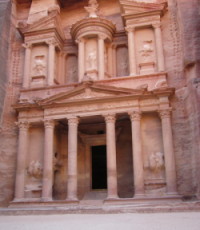
Photo. Khasneh at Petra in Jordan. © Travel Explorations.
Created without modern machinery, many of these monuments still challenge engineers and archaeologists. Their scale, precision and endurance are reminders of what ancient civilisations achieved with remarkable skill, determination and ingenuity.
Every archaeological site has its own story. Some were once thriving capitals, others were sacred ceremonial centres or prosperous trading cities that were later abandoned, buried beneath sand, reclaimed by jungle or frozen in time by natural disaster. From the pyramids of Egypt and the standing stones of Stonehenge to Chichén Itzá and the Acropolis overlooking Athens, each reflects the beliefs, ambitions and craftsmanship of the people who built it.
For adventure travellers, these places offer far more than impressive scenery. They provide the chance to follow ancient roads, climb forgotten stairways and stand in spaces where rulers, merchants, priests and ordinary people lived their daily lives. Weathered stonework, faded carvings and centuries-old pathways reveal stories that no history book can fully capture.
The most rewarding journeys often lead into the past. Whether crossing Egypt's deserts, exploring Cambodia's jungle temples, hiking through Peru's Andes or discovering the ruined cities of Central America, these remarkable places offer a deeper understanding of both history and humanity.
History is not confined to museums. It survives in landscapes, monuments and archaeological sites that continue to shape our understanding of the world.
Archaeological sites are far more than collections of ancient ruins. They preserve evidence of how earlier civilisations lived, governed, traded, worshipped and built societies whose influence still reaches into the present.
Some rise from vast deserts, others emerge from dense forests or sit high on remote mountain ridges. Many stand alongside modern cities, creating striking contrasts between the ancient and the contemporary. Each offers a different perspective on human history.
Among the world's most remarkable archaeological sites are:
Caral-Supe, Peru - the oldest known city in the Americas
Hegra (Mada'in Saleh), Saudi Arabia
Petra, Jordan
Machu Picchu and the Inca sites, Peru
Ayutthaya, Thailand
Ring of Brodgar, Scotland
Newgrange, Ireland
Carthage, Tunisia
Altamira Cave, Spain
Lascaux Cave, France
The Great Sphinx of Giza, Egypt
The Pyramids of Giza, Egypt
Alexandria, Egypt
Mohenjo-daro, Pakistan
Jerusalem
The Rock-Hewn Churches of Lalibela, Ethiopia
Pompeii, Italy
The Ziggurat of Ur, Iraq. In fact, Iraq is arguably the cradle of archaeology. If you're compiling the world's greatest archaeological sites, Iraq deserves more representation than just the Ziggurat of Ur.
Teotihuacán, Mexico
The Colosseum, Rome
The Acropolis, Athens
Chichén Itzá, Mexico
The Great Wall of China
Stonehenge, England
Taktsang Monastery (Tiger's Nest), Bhutan
The Nazca Lines, Peru
Tikal, Guatemala
The Ġgantija Temples, Malta
Angkor Wat, Cambodia
Persepolis, a ceremonial capital of the Achaemenid Persian Empire
Baalbek, home to some of the largest Roman temples ever built
Göbekli Tepe (Türkiye), the world's oldest known monumental temple complex.
Nan Madol, an ancient ceremonial city built on nearly 100 artificial islets connected by canals, often called the "Venice of the Pacific."It was the ceremonial and political centre of the Saudeleur dynasty between about AD 1200 and 1700. It was constructed from massive basalt columns, some weighing many tonnes, transported without modern machinery. It is one of the few ancient cities built entirely on artificial islands. It is the most important archaeological site in Oceania and a UNESCO World Heritage Site.
These places represent some of humanity's greatest achievements. They demonstrate engineering skill, artistic vision and cultural ambition on a scale that continues to impress thousands of years after they were built. Visiting them is not simply about seeing famous landmarks; it is an opportunity to better understand the people who created them and the civilisations they left behind.
Italy has more UNESCO-recognised archaeological treasures than any other country, ranging from the Roman cities of Pompeii and Herculaneum to the Greek temples of Agrigento and the Bronze Age nuraghi of Sardinia (source: Guinness World Records website).
Ancient wonders are found on every continent, each offering a different chapter in the story of human civilisation. Exploring them is one of the most rewarding ways to connect with the past.
Stein Morten Lund, August 2026
Additional information
According to Guinness World Records website:
the country with the most World Heritage Sites, ascribed by the United Nations Educational, Scientific and Cultural Organization (UNESCO), is Italy, with 61 locations of historical and cultural significance as of 12 July 2025. The most recent Italian sites to be granted this protected status include the porticoes (sheltered walkways) of Bologna (in 2021), the karst and caves of the Northern Apennines (2023), Roman-built road the Via Appia, or Appian Way (2024) and the Domus de Janas rock-cut tombs of Sardinia (2025). Italy sits just ahead of China with 60 World Heritage Sites, Germany with 55 and France on 54, as of 12 July 2025.







 E-mail this
 Print this