Cēsis Castle, Latvia - A spooky adventure
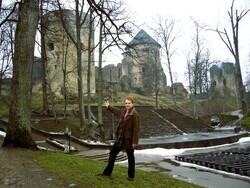
Photo. Cēsis Castle, Latvia, where history hits hard. © Travel Explorations.
No crowds and noise. Just us, the ruins, and that slightly uncomfortable feeling that perhaps we weren’t completely alone.
Cēsis is a beautiful 800-year-old medieval town about 1.5 hours northeast of Riga, on the edge of Gauja National Park. At its heart stands one of Latvia’s most fascinating, and perhaps spookiest historic places: the Cēsis Medieval Castle.
Built in the early 13th century, the castle became one of the most important strongholds of the Livonian Order and served for centuries as a centre of political and military power. Latvia is dotted with historic castles, manor houses and palaces, but the ruins at Cēsis have an atmosphere all their own.
Cēsis Castle stands as a witness to more than 800 years of dramatic and eventful history. Five centuries ago, it was one of the most powerful medieval fortresses in Livonia. Its walls witnessed wars, sieges and struggles for control involving some of the great powers of the Baltic region. Today, it remains one of Latvia’s most impressive medieval castle ruins. This is a place where we felt history remarkably near.
With every dark passage and crumbling wall, the Middle Ages suddenly didn’t seem so far away. We wandered deeper into the castle, imagining the knights and crusaders who once walked these grounds. But behind the romantic image of medieval knights lies a much darker story.
The darkest chapter came in 1577, during the Livonian War, when the forces of Ivan the Terrible laid siege to Cēsis. After five days of bombardment, around 300 people sheltering inside the castle reportedly chose death rather than surrender. They gathered around barrels of gunpowder and blew themselves up, destroying part of the fortress. It remains one of the most tragic episodes in Cēsis Castle’s long and turbulent history.
Standing among the silent ruins beneath a grey Latvian sky, surrounded by crumbling stone walls and wild greenery, that dramatic past suddenly felt uncomfortably close. Maybe our spooky feeling wasn’t entirely imagination after all.
Stein Morten Lund, November 2007
Additional information
Latvia is a country in Northern Europe on the east coast of the Baltic Sea, featuring a flat landscape, dense forests, and a rich history shaped by centuries of cross-cultural influence. It is one of the three Baltic states. It borders Estonia, Russia, Belarus, and Lithuania.
Latvia is a Baltic gem where medieval towns, ancient castles, and wild landscapes tell stories stretching back more than eight centuries. There you can wander through UNESCO-listed streets, explore atmospheric fortresses, and discover traditions shaped by merchants, kingdoms, and empires. Beyond the history lies a quieter Latvia of forests, rivers, and Baltic shores.







 E-mail this
 Print this