Varosha, Cyprus - My day in no-mans land
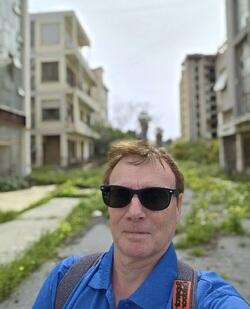
Photo. Me into the ghost town Varosha, Famaguasta in northern Cyprus - A day in no man`s land. © Travel Explorations.
Crossed the military green line into Varosha with passport in my hand, and I knew I had return the same day (no overnight stay is legal). You must use an official checkpoint when entering and leaving. It can cause troubles if you are not a British citizen.
Ahead of me lay Varosha. A city suspended between memory and silence. Walking into that no-man’s land felt like crossing into another dimension. The air changed. The noise of the world faded. And suddenly, there was nothing. No cars, no voices, or life life at all. Only the sound of silence.
Walking through Varosha at the eastern coast of Cyprus was one of the strangest things I ever have experienced. The city looked like a ghost town, trapped between what was and what will never be again.
Empty streets stretched out before me, lined with collapsing buildings that once held dreams, laughter, ordinary lives. Hotels stood like hollow giants, their windows staring blindly at the sea. Nature had begun to reclaim what humans abandoned in fear and haste.
I could walk down the main street. Sit, and stop and breathe. And feel time pressing in from all sides. It wasn’t just a ghost town. It was a time capsule for over 50 years.
On my way I stopped in front of the Bank of Cyprus in Varosha, frozen in time like every thing else there. No service today.
Cyprus has a long history of invasions because of its strategic position between Europe, Asia, and the Middle East. Over centuries, it was ruled by empires like the Byzantines, Venetians, and Ottomans, before coming under British control in the 19th century. Tensions grew in the 20th century between Greek Cypriots who mostly wanted union with Greece, and Turkish Cypriots who feared being marginalized.
Once Varusha was the "Las Vegas of the Eastern Mediterranean". Following the 1974 conflict, it was fenced off as a military restricted zone. The inhabitants left over night their homes, luxury hotels, boutiques, bars, petrol stations as Jet, car sellers as Toyota, banks as Bank of Cyprus and Bank of Scotland, to be reclaimed by nature.
This is a really tragic story litterally stored in a time capsule box. Perhaps intended for preservation and future discovery, to show future generations what life was like then. And perhaps one day it will rise again from the deepest dark.
A place where life didn’t end. It simply paused. Frozen in the moment when everything changed, when people fled and never returned. Even knowing the history—the division of Cyprus, the military presence, the decades of closure, nothing prepares you for standing inside it.
Military patrols were still there. Watching me looking around and taken photos. So I had to be careful what I took photos of. Reminding you that this silence is not accidental, but enforced. And yet, the deeper I walked, the more surreal it becomes.
I found myself imagining the nights.
- How dark they be?
- Totally silence?
- What does a city dream about when no one is left to remember it?
- And is the real ghosts coming out at that time?
For a moment, it felt like standing at the edge of the world. A place caught between what was and what will never be again.
Cyprus has a long history of invasions because of its strategic position between Europe, Asia, and the Middle East. Over centuries, it was ruled by empires like the Byzantines, Venetians, and Ottomans, before coming under British control in the 19th century. Tensions grew in the 20th century between Greek Cypriots (who mostly wanted union with Greece) and Turkish Cypriots who feared being marginalized.
Turkey invaded Cyprus on 20 July 1974 in a military operation called “Operation Atilla,” following a coup backed by the Greek junta five days earlier. The coup removed President Archbishop Makarios III and installed Nikos Sampson, aiming to unite Cyprus with Greece.
Cyprus was invaded in two phases, leaving around 36–37% of the island under Turkish control. The conflict forced massive displacement, about 150,000 Greek Cypriots fled south, while around 60,000 Turkish Cypriots moved north. Around 2,000 people from both communities were reported missing after 1974 (source: Committee on Missing Persons in Cyprus (CMP).
The island was divided by the UN-monitored Green Line, a separation that still exists today. In 1983, the Turkish Republic of Northern Cyprus was declared. It`s only recognized by Turkey.
And still, the future of Varosha remains unwritten. That is what makes it so powerful. Not just a relic of the past, but a question mark in the present. What will happened in the future is still a open question.
Stein Morten Lund, April 2026
Additional information
Read more on our website Travel Explorations about the “Opened wound” from the event in 1974 and still many missing people. Where are they?
Varosha, Cyprus - The silence that still speaks.
The aim of the coup that lead to the Turkish invasion was the union (enosis) of Cyprus with Greece, and the Hellenic Republic of Cyprus to be declared. Turkish forces landed in Cyprus on 20 July 1974 and initially captured about 3% of the island before a ceasefire. After peace talks failed, a second offensive in August expanded control to around 36%. The ceasefire line later became the UN Buffer Zone, known as the Green Line. The conflict displaced around 150,000 Greek Cypriots to the south and about 60,000 Turkish Cypriots to the north—marking one of the island’s most dramatic and painful divisions. Read more about the dramatic history on Wikipedia. Turkish invasion of Cyprus.
https://en.wikipedia.org/wiki/Turkish_invasion_of_Cyprus







 E-mail this
 Print this