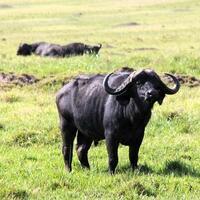
Photo. The Cape buffalo is a reminder that Africa's wildlife deserves both admiration and caution.
It is a gentle giant until you give him a reason not to be. Then you suddenly remember your safari vehicle has a reverse gear. It is calm for most of the day, the Cape buffalo can become remarkably aggressive when threatened.
Few animals embody the strength, resilience and raw power of the African wilderness quite like the Cape buffalo. This photograph captures a Cape buffalo watching its surroundings, while other rests quietly in the background. It's not unusual to see a cattle egret perched on its broad back, feeding on insects disturbed by the buffalo's movements. This is a simple reminder of how closely connected life is on the savanna.
From open grasslands and floodplains to swamps, mopane woodland and dense thickets, the African buffalo has adapted to an impressive range of habitats.
Never underestimate a buffalo and never argue with one. If you get into trouble, make sure the engine is running, or that you can run very, very fast.
The Cape buffalo is found across much of eastern and southern Africa. In Kenya, it is commonly seen in the Maasai Mara, Amboseli, Tsavo and many other protected areas. In Tanzania, large herds roam the Serengeti, the Ngorongoro Conservation Area, Nyerere National Park, Ruaha National Park and other reserves.
As one of Africa's famous Big Five, the Cape buffalo commands respect. A mature bull typically weighs between 500 and 900 kilograms. Although it feeds almost entirely on grass, it is one of Africa's most formidable wild animals. Its heavy, sweeping horns, muscular build and ever-watchful stare give them plenty of character.
Stein Morten Lund, 8th August 2026






 E-mail this
 Print this