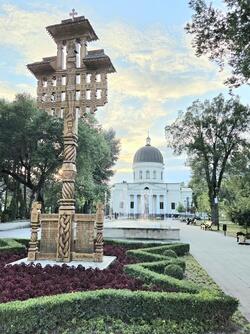
Metropolitan Cathedral of Christ's Nativity in Cathedral Park, Chisinau, Moldova.
Photo. The Metropolitan Cathedral of Christ's Nativity. © Travel Explorations.
Moldova is a small Eastern European country located between Romania to the west and Ukraine to the east. Known for its rolling countryside, vineyards, and rich cultural heritage, Moldova sits at a crossroads between Eastern and Western Europe. Despite its modest size, the country has a complex history shaped by centuries of shifting borders, empires, and political influences. And not forget religion, which has played a significant role in shaping Moldova's identity, culture, and history.
Throughout its history, Moldova has been influenced by a variety of religious traditions, reflecting its position between Eastern and Western Europe. The dominant faith has long been Eastern Orthodox Christianity, which arrived in the region during the medieval period through the influence of the Byzantine Empire. For centuries, monasteries and churches served not only as places of worship but also as centers of education, culture, and resistance during periods of foreign rule.
I arrived in Chișinău on 7th July 2026 expecting to see another city landmark, but what I found in Cathedral Park felt far more meaningful. The park itself was a peaceful green oasis, filled with wide paths, mature trees, and a calm atmosphere that seemed to soften the pace of the capital. After a long day of travelling from Norway, I finally slowed down.
Standing in the park on a warm, sunny afternoon, there was something profoundly surreal about seeing the Metropolitan Cathedral of Christ's Nativity so peaceful, radiant, and full of life. It was difficult to imagine the scenes before me with the turbulent history it had endured. The very ground where visitors now stroll beneath the trees witnessed World War II bombings, Soviet-era destruction, and decades during which religious life was suppressed. Today, the cathedral has been fully restored to its role as the spiritual heart of Moldova, showing few outward signs of the hardships it survived.
Moldova, a small landlocked country tucked between Romania and Ukraine, is a hidden gem of Eastern Europe. Known for its world-class wine culture, ancient cave monasteries, rolling countryside, and warm hospitality, it remains one of Europe’s least-visited destinations. Yet for curious travellers, Moldova offers something increasingly rare: authentic experiences, rich traditions, and the feeling of discovering a place that still lies beyond the usual tourist trail.
In Chișinău, Moldova's spiritual heritage is impossible to miss. The city skyline is shaped by historic churches and cathedral domes, reflecting a faith that remains deeply woven into everyday life. Across the country, approximately 1,500 Orthodox churches and around 50 monasteries continue to serve local communities.
The Metropolitan Cathedral of Christ's Nativity, built in 1830, is the most important Orthodox cathedral in Moldova. Unlike many Orthodox churches known for their elaborate Byzantine architecture, this cathedral was designed in a striking neoclassical style. Its elegant symmetry, bright white façade, and imposing columns give it a distinctive character.
As the afternoon sun began to lower, the cathedral seemed to come alive. The contrast between the brilliant white columns and the deep blue sky was captivating. Light danced across the façade, while the dome reflected the sun with a quiet elegance that made it impossible to look away.
Standing at the centre of Cathedral Park, directly opposite the Triumphal Arch, the cathedral seemed to anchor the city around it. I found a quiet spot beneath the trees and simply absorbed the scene. There was no rush, no agenda, just a rare moment of stillness.
What fascinated me most was not only the beauty of the building but the story it told. Looking at its restored walls, it was difficult to imagine the destruction and neglect it had once endured. Yet perhaps that was precisely its message. The cathedral stands today not as a monument to perfection, but as a testament to endurance.
As I watched locals pass by, I found myself reflecting on how places often mirror the people who live around them. Like the cathedral, cities, and perhaps all of us, carry scars that are not always visible. Some wounds fade with time, while others become part of our identity. Yet resilience is not about erasing the past. It is about rebuilding, adapting, and continuing forward.
In that quiet corner of Chișinău, beneath the glow of the afternoon light, I was reminded that the greatest strength is often found not in what survives untouched, but in what rises again after being broken.
Stein Morten Lund, 14th July 2026







 E-mail this
 Print this