Photo. Even the most beautiful football can quickly descend into hostility when pride, pressure and fear collide.
Pelé, Brazil’s great icon and the only player to win three World Cups, helped give football its image as o jogo bonito, the beautiful game. Yet not every player, team or match has lived up to that ideal. Around the world, there were players who became feared as much for their tackles as their football.
The Battle of Santiago: Chile v Italy, 1962 World Cup
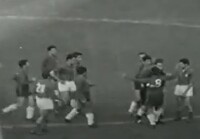
Often described as one of the most violent World Cup matches ever played, Chile against Italy in 1962 was brutal from the start. Players punched, kicked and fouled with little restraint, and police had to intervene more than once. BBC commentator David Coleman called it “the most stupid, appalling, disgusting and disgraceful exhibition of football” he had ever seen.
Estudiantes v AC Milan, 1969 Intercontinental Cup
This match felt less like football than open warfare. Estudiantes played with frightening aggression, and Milan goalkeeper Néstor Combin was left with a broken nose and badly swollen eyes. Several Estudiantes players were later arrested.
The Battle of Nuremberg: Portugal v Netherlands, 2006 World Cup
With 16 yellow cards and four red cards, this became one of the most notorious matches in World Cup history. The football disappeared beneath a stream of fouls, confrontations and revenge tackles.
Manchester United v Arsenal, 1990: The Battle of Old Trafford
A fierce tackle sparked a brawl involving almost every player on the pitch. Arsenal won 1–0, but both clubs were punished, and the match became part of the growing hostility between two of English football’s biggest rivals.
England v Italy, 1934: The Battle of Highbury
Italy arrived as world champions, but the match soon became a bruising contest. England suffered several injuries, including a broken foot, in a game remembered more for its physicality than its football.
Brazil v Chile, 1989 Copa América
This was scandal rather than violence. Chilean goalkeeper Roberto Rojas secretly cut himself with a razor hidden in his glove, pretending he had been struck by a firework thrown from the crowd. The deception was exposed, and Chile were later banned from the 1994 World Cup.
Turkey v Switzerland, 2005 World Cup play-off
After Switzerland knocked Turkey out of World Cup qualification, the match ended in a mass brawl involving players and staff. FIFA later described it as one of football’s darkest moments.
Argentina v England, 1966 World Cup: The Battle of Wembley
Argentina captain Antonio Rattín was sent off but refused to leave the pitch for several minutes, adding to the tension of an already bad-tempered match. England manager Alf Ramsey later called the Argentine players “animals”, a remark that deepened the rivalry between the two nations.
Leeds United v Barcelona, 1975 European Cup semi-final
This was not the bloodiest match on the list, but it was one of the most controversial. Leeds beat Barcelona over two legs, but the tie was full of bad tackles, disputed decisions and crowd trouble. Terry Yorath’s challenge on Johan Cruyff left the Dutchman injured, while Leeds felt several penalty claims were ignored. At full-time in Barcelona, angry fans threw missiles and seats onto the pitch.
Leeds United v Chelsea, 1970 FA Cup final
The 1970 FA Cup final, and especially the replay, remains one of the most ferocious matches in English football. Leeds and Chelsea kicked, shoved and hacked at each other in a contest that would almost certainly produce multiple red cards under modern rules.
Netherlands v Brazil, 1974 World Cup: The Battle of Dortmund
This was supposed to be a clash between two of the world’s most gifted footballing sides, but it turned into one of the dirtiest matches of the 1974 World Cup. Brazil, the defending champions, tried to disrupt the Dutch “Total Football” system with persistent fouling and physical intimidation. The Dutch responded in kind as tensions escalated throughout the match.
The game featured a stream of reckless tackles, confrontations and cynical fouls. Brazilian midfielder Luís Pereira was eventually sent off after a brutal challenge on Johan Neeskens, the first red card shown in World Cup history after red and yellow cards were officially introduced in 1970. The Netherlands won 2–0 and reached the final, but the football itself was overshadowed by the violence. It was a reminder that even brilliant football can turn ugly when the pressure becomes overwhelming.
Looking back, it is hard to imagine many of these matches finishing with 11 players on each side today. Football has changed. Stricter refereeing, VAR, better discipline and greater concern for player safety have removed much of the old brutality.
Yet these matches still fascinate us because they show football at its rawest: tribal, emotional and sometimes dangerously uncontrolled. The beautiful game has always carried a darker edge. Perhaps that is part of its power. It can bring people together, but it can also expose pride, fear, rivalry and rage in their most public form.
Stein Morten Lund, May 2026
Additional information
Additional comment from Editor-in-Chief Stein Morten Lund:
When I think back to English football in the 1970s and 1980s, a few names immediately come to mind for all the wrong reasons: Norman Hunter, nicknamed “Bites Yer Legs”, Ron “Chopper” Harris and later Vinnie Jones. Players like that would struggle to last five minutes in the modern game without being sent off. Roy Keane, Tommy Smith and Neil Ruddock also built reputations on intimidation as much as football.
Back then, crunching two-footed tackles, elbows and late challenges were often dismissed as simply “part of the game”. Today, most of those incidents would go straight to VAR, followed by a red card and probably a suspension.
At times, some defenders looked more interested in hurting opponents than winning the ball. Certain tackles from that era now seem astonishingly reckless: These sort of challengeswould trigger outrage if they happened in a modern Premier League match. Goalkeepers were not protected either. Strikers regularly charged into them at full speed, and referees often waved play on.
And it was not just an English phenomenon. Football around the world has seen players whose reputations were built as much on aggression and fear as skill. The game was harder, rougher and far less regulated than it is today which is partly why so many of those infamous matches still stand out decades later.







 E-mail this
 Print this