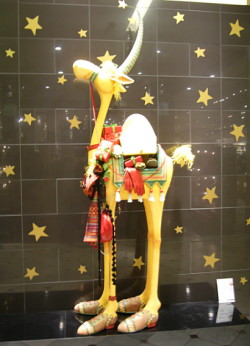
Photo. A dromedary in a shopping centre in Copenhagen. Santa has to travel flexible - by elephants, horses, camels and dromedaries! But where is Santa Claus and his trusted reindeer?
The genuine Santa Claus, whether he comes from Norway or Korvatunturi in Finnish Lapland, he has a long way to go, and he has to use the most suitable transport. But on the big and modern boat, the danskebåten Pearl of Scandinavia - DFSD Seaways, the Santa Claus spoke Danish, and in Copenhagen Santa`s transportation was dromedary.....
Of all places I found this dromedary in a shopping centre in Copenhagen in Denmark. Dromedary is one-humped camel. Probably it`s because the Danish believe that reindeers can`t fly. The genuine Santa Claus, whether he comes from Norway or Korvatunturi in Finnish Lapland, has a long way to go, and of course he has to use the best suitable transport to reach all the world`s frontiers.
Norwegians enjoy their time now to celebrate PreChristmas in their own traditional way. They suck in the great Christmas atmosphere on ships from Norway to Denmark. They take the opportunity on the ships to enjoy a wide range of onboard leisure, eating heavy Christmas food, partying and just sail way.
In Copenhagen they enjoy their stay in city centre Strøget for shopping, walk around in Nyhavn Canal, where but also have real fun and suspence thrill in the Tivoli Gardens. The big Tivoli park is full of seasonal festivities. It has Christmas market, several entertainments, amusements, Tivoli Lake for ice skating, spectacular lighting on a big Christmas Tree in the front of the snow palace Nimb Restaurant, fun rides and a fairytale garden. Check out the Yule goblins, the hamlet of Goblinsville - Nissekøbing - with over 100 mechanical pixies (in Danish: nisser) and listen to Christmas music performed by Hobgoblin Band. Here you will also meet Santa Claus - Father Christimas, and he speaks Danish, which has its own charm.
Santa transportation
Santa seldom use other transportation than Reindeers (see the photo above). The species of camel which was in common use among the Jews and the heathen nations of Palestine was the Arabian or one-humped camel, Camelus arabicus. The dromedary is a swifter animal than the baggage-camel, and is used chiefly for riding purposes; it is merely a finer breed than the other.
The Arabs call it the heirie. The speed of the dromedary has been greatly exaggerated, the Arabs asserting that it is swifter than the horse. Eight or nine miles an hour is the utmost it is able to perform; this pace, however, it is able to keep up for hours together. The Arabian camel carries about 500 pounds.
The camel is often found around ancient ruins in Petra in Jordan. mostly for taking the tourists around in the huge ancient city. The locals do it for living, and the visitors get a unique memory without getting too exhaustet in the heat.
The hump on the camel's back is chiefly a store of fat, from which the animal draws as the wants of his system require; and the Arab is careful to see that the hump is in good condition before a long journey.
|
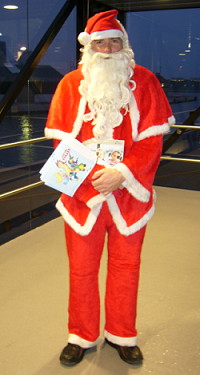
Photo. The nice Danish speaken Santa Claus on the boat Pearl of Scandivia - DFDS.
Some children become frightened when Santa emerged, but I told them there was nothing to worried about: "This Santa Slaus is not genuine because he speaks Danish".
|
 |
Another interesting adaptation is the thick sole which protects the foot of the camel from the burning sand, with a web between the toes. The nostrils may be closed by valves against blasts of sand. Most interesting is the provision for drought made by providing the second stomach with great cells in which water is long retained. Sight and smell are exceedingly acute in the camel.
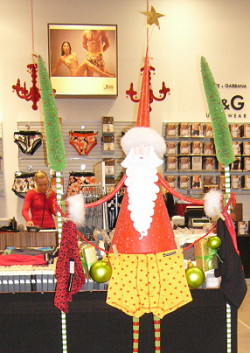
| Photo. Santa Claus in the shopping centre Illum in Copenhagen. |
 |
Get into the spirit of Christmas on the Danskebåtene DFDS Seaways, Stena Line and Color Line from Norway to Denmark. It`s a big party going on here now! Meeeerrry Christmas!
Stein Morten Lund, 5 December 2005
Additional information
DFDS Seaways is part of the DFDS Group of Companies, one of the largest in Denmark. The name DFDS comes from the original name under which the company was founded in 1866: Det Forenede Dampskibs-Selskab (The United Steamship Company).
DFDS`s website:
www.dfds.co.uk (in english)
www.dfds.no (in Norwegian)
Stena Line: www.stenaline.com
Color Line: www.colorline.com







 E-mail this
 Print this